
What Is An Output?
It's why you hire people. PLUS a Big Announcement

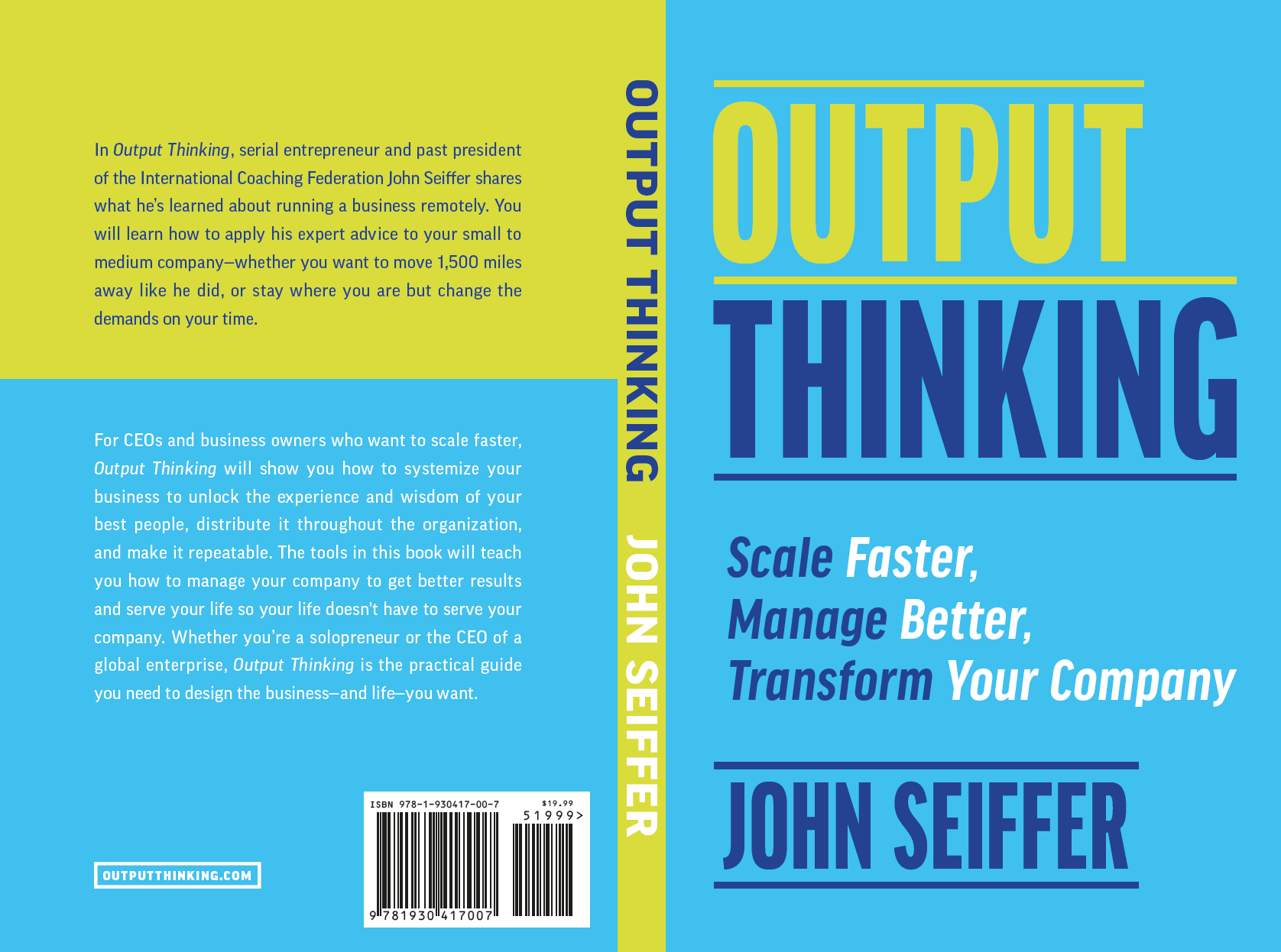
My book, Output Thinking is now available for Pre-order Special
If you pre-order before Dec 5 and email a copy of the receipt to John@CEOBootCamp.com I'll send you a PDF copy you can read before release date and hopefully, write a review after it's released (Dec 7). Order at https://www.amazon.com/dp/B0CLDH963G or click the QR code.

Here's an excerpt from the book.
Chapter 3: What is an Output?
There’s a child’s fairy tale about a shoemaker who cut his leather into pieces and left them on his table to make into finished shoes in the morning. While he was sleeping, the magic elves came in and finished up all his shoes. I guess it was the slow season at Santa’s workshop. As soon as the shoes were finished, the elves disappeared. In the morning, the shoemaker woke up and the elves were gone, but he knew they’d been there. How did he know? He saw finished shoes where before there had been only pieces of leather piled on the table.
So if your people were elves, and they did their job in the middle of the night, how would you know what they’d done when you came to work in the morning? If you can describe that, you’ve described the output you expect from someone performing the function of “shoemaker” or whatever.
An output is something visible: it’s an outcome, a deliverable, an obvious behavior; something produced after doing some work. It could be something physical, like a marketing brochure or a hamburger. It could also be a change in status—if your job is to clean a room, then a clean room is the output. It can even be something intangible like a relationship or a decision. But it is demonstrable and discernible. If you’ve ever defined the scope of work for a contractor, you’ve described the results you’re willing to pay for. That’s what I’m calling output.
Six kinds of outputs
Before we get too far down this path, I want to talk about semantics. Consultants are famous for using normal words in slightly specific ways and charging people lots of money for it. I’m more interested in you understanding a concept than in what you call it.
For example, if you do a Google search for “outputs vs outcomes” you’ll find a number of writings about the distinction (which I think is a distinction without a difference). BMC’s article on it says an outcome is what the company needs to achieve, while outputs are the actions that contribute to achieving that outcome. (https://www.bmc.com/blogs/outcomes-vs-outputs/) They say that if a bakery makes a Spiderman cake for a kid’s birthday party, the cake is the output but happy kids are the outcome.
To me, the relevant distinction here is that there are some things you can control (the quality of the cake) and some you can’t (how people react to it). Your job as a business owner is to learn as much as you can about how people will react (knowing you’ll never be able to predict it 100%), then use that insight to determine what your people can control and do your best to make the two line up. I don’t think the labels are critical if you understand the concepts. I may even use “output” and “outcome” interchangeably along with “results” and “deliverables.” I hope that doesn’t bother you.
What I hope you see here is that looking at a company as a collection of outputs is fundamentally different from looking at that same company as an org chart of people, regardless of whether we call them outputs, outcomes, or results. So, with that said, here are six different kinds of outputs.
An output can be a thing
The elves produced shoes, for example. A salesperson’s output is signed contracts.
An output can be a change in status
A janitor makes a room clean: that’s their output. They don’t make the rooms, but they make them clean. An inspector’s output is approved parts that can go into inventory. Again, they don’t make the parts, but they change the status to approved or rejected.
Outputs can be behavioral but don’t mistake them for attitudes
Sometimes output describes a behavior rather than a physical item. When that’s the case, be sure to define what exact behaviors you want to see, not just what “attitude” you’re looking for. Here’s what I mean.
It’s common to hear employees described as having a good attitude (or a bad one). People will say someone is a “team player,” or they really “get it.” This is not output thinking. It’s a mental shortcut we humans tend to use to communicate a number of behaviors. But these words can mean different things to different people. What behaviors does a “team player” do that someone who is not a team player doesn’t do?
You’ll see this when a company does a values exercise to name the values they view as important, but doesn’t describe how to make those values visible. People usually leave these exercises thinking, “I wonder how much that exercise cost the company?” It’s not bad to define values. Getting a company’s culture right can be very powerful. But it’s more useful to describe visible behaviors you want in your culture than to use words like attitudes or values.
Bretton Putter of CultureGene.ai does a lot of work helping companies define their values. This is particularly useful for companies with remote workers who can’t communicate their culture the way companies can when everyone’s physically together. One of his exercises is to have each person take the words in a company’s list of values and write what it means to them and how they see it in action.
Pause for a moment and imagine that “honesty” was one of your company values. Get out your CEO Notebook and jot down how you’d see it in action.
.
.
.
I’ll wait.
.
.
.
.
OK. Done?
Here’s what some people wrote. See how close it comes to what you wrote.
Honesty means …
We are known for candor and directness.
We give considered and constructive feedback.
We are quick to admit mistakes.
We never talk behind another person’s back.
It’s not that these expressions of honesty are better or worse than yours. I have reservations about some of them myself. The point is that they are expressed in a more visible way than just the word “honesty.” If you want people to live the values of your company culture, you have to describe them in visible, behavioral ways that everyone can agree on.
Let me give you another example. I recently had to take several flights with an injured leg that I could not put any weight on. So I was using a contraption called an iWALK (which I highly recommend). As a result, I was interacting with a number of flight attendants on the different flights and I noticed that I felt some of them were friendly and some of them were grumpy. But those are attitudes. So I started to think about what behaviors led me to those judgments. Here’s what I came up with: eye contact (or lack of it), smiles not frowns, proactively asking if they could help me rather than waiting to be asked. Things like that are behaviors that are visible. It’s tempting to say some of those people cared more—but honestly, I don’t know what they felt. I just know what they did.
Outputs can be decisions
People in companies make decisions all the time. Some of those decisions are one-offs. Some are made over and over again. Someone is charged with making these decisions and they are part of that person’s output. Here are some examples of repetitive decisions.
Extending credit. Many companies need to decide whether they should sell to customers on credit or demand cash on delivery (COD). If they give the customer credit, they need to decide how much. These are examples of decisions that are made repeatedly. It’s an output that’s required if a sale is to go forward. You’d want to know who’s responsible for producing that output so they can be trained and their decisions tracked and improved.
Hiring and firing. Often there are guidelines from HR to ensure these decisions are made in compliance with laws and regulations, but the decisions still have to be made by someone.
Strategy decisions are made by the top-level management of a company. These are decisions about which markets to go into and which products to carry.
Every decision needs to be made by someone, and like any output, the person in charge of making a decision may change as you promote people and your company grows. But the decision must be made no matter who makes it. That’s why it’s useful to specify certain types of decisions as outputs. Then they can be assigned to people and those people can be trained and evaluated. Don’t view decision-making as an innate skill of the individual. See it as an output that people can be trained to do better.
One advantage of this approach is that decisions can be made by people lower down in the organization once they are trained properly. This means people at the top will be interrupted less because the way they make decisions can be replicated. If you think this is impossible, consider that some of the best companies in the hospitality industry routinely train entry-level desk clerks and food servers to make decisions on the fly that result in great service.
Solving problems is an output
As someone moves up through the ranks of a company, it’s common that their promotion is due to their ability and responsibility to solve different levels of problems. You would think solving problems is always a good thing. But whether it’s good or not can depend on who does it. Let me give you an example of where it’s not.
Companies who do a lot of tech support often have different levels of support. Level 1 people can solve the problems that are most common and the simplest. If they can’t solve a problem, they’ll elevate it to a level 2 person and so on.
Companies do this because level 3 people are more expensive and harder to recruit than level 2 people, who are more expensive than level 1 people. If the level 3 people spent their time telling us to reboot our computers, it would be wasteful. So you don’t just want anyone spending time solving any and all problems. You want problems solved by the right people who can do it most effectively. This links to the concept of everyone playing at the top of their game—something we’ll cover a little later.
Parceling out problems requires a process known in the medical world as triage: assessing the urgency of the problem and matching it with the person who can best solve it. Good triage is an output in its own right. If the system of triage and allocation of problems is not done well, it can be annoying to your customers. But that’s a different issue from who actually solves the problems.
By thinking of problem-solving as an output, you can assign problems to people with the proper skills and training.
Relationships can be an output
Business development people are expected to cultivate relationships with potential customers or joint venture partners. Those are the outputs they are expected to produce. Relationships are also key outputs for business owners. They often have relationships with important suppliers or long-standing customers. This becomes important when an owner is exiting the company. Those relationships need to be transferred to someone else in the company or there will be problems for the new owner.
But it’s not just the owner. If you consider that people will move in and out of your company, you want all of their business relationships to stay with the company. This should be considered when you decide if employees will be able to use their own laptops, cell phones, and emails when doing business.
Tips for defining outputs
Defining an output can be a little tricky—especially with knowledge workers. You might think some of the things I’m calling outputs are the work people do, and you wouldn’t be wrong. But there’s more to it than that. The work is what they do to produce the output; the output is the reason for the work. If you want to grow your company, it’s important to describe the outputs separately from the work. Otherwise you won’t be able to improve the systems and scale the company.
If you’re having trouble describing an output, here are some things to try.
Consider the elves. If one of your employees did their work in the middle of the night and went home before you arrived, how would you know that they did a good job? What would you see? That’s the output you want from them.
If you could only hire contractors, not employees, how would you define the scope of work for the contracts? Scope of work should focus on what they are expected to produce. Why not do that for employees?
If you had to run your company from a desert island with no internet, what would you need to see in a weekly message in the bottle that floated in from the company to know the company was on track? Those are likely the outputs you’d want to know about.
Imagine two people in the same role producing similar outputs. One does a decent job and one does a great job. What do you notice about the difference? How would you explain the difference to someone who didn’t know the two people?
Pick an employee. Imagine they were out on extended leave. Make a list of the things you’d have to get someone else do to fill the gap they left. That’s a list of the outputs they produce. You’ll likely find that only some of them are directly related to their role or job description. Discuss that list with the person and see what they can add to it.
CEO TIME: List the outputs
Pick one of your direct reports. Use one or more of the techniques above to list all the outputs you expect from them. Be as specific as possible (as if they were an elf).

Then check with them and see if they agree with your list. Maybe they didn’t realize you expected certain outputs from them. Maybe they produce outputs that you didn’t realize they spend time on.

This may lead to you and them reprioritizing what they work on. If you’ve done this well, what you’ll have is the basis for their performance review in a format that will be obvious to both of you. We'll cover performance reviews in Chapter 5.
I hope you enjoyed that excerpt. The book contains 20 CEO Time exercises like the one above designed to help you work ON your business.